Chronic Illness, Mortality, and Never Leaving Angry
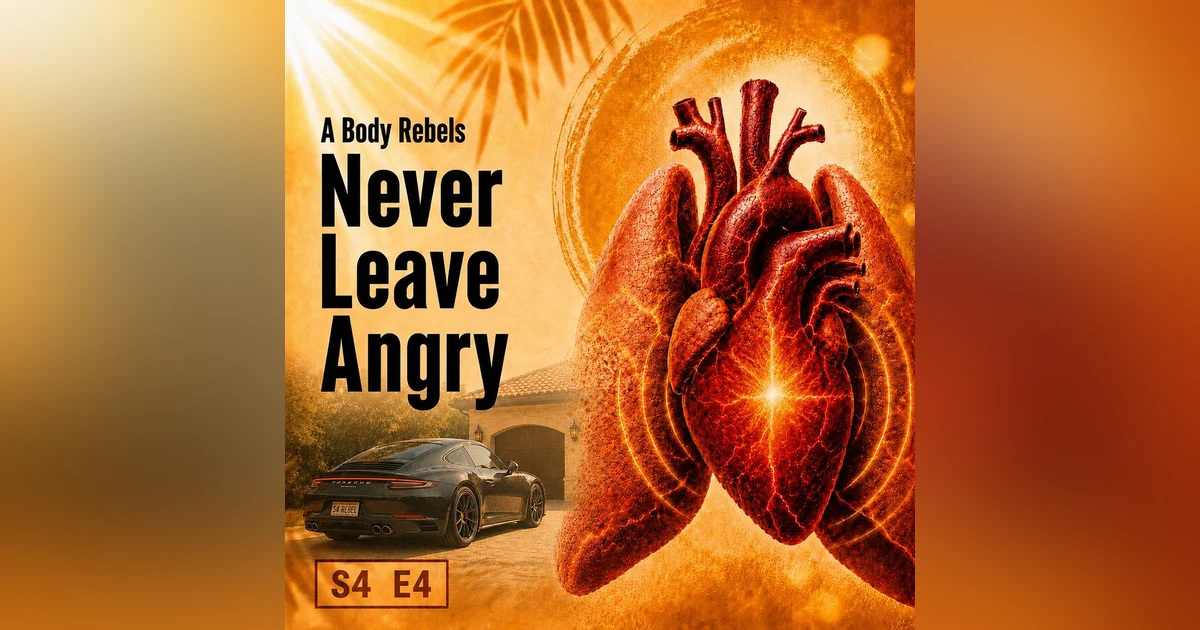



In this episode, I talk about an ordinary drive home that turned into a quiet reminder of how fragile life can be. I’m reflecting on a young neighbor’s sudden death, the strange grief of witnessing loss from a distance, and the promise my wife and I made never to leave each other angry. I also talk about chronic illness, uncertainty, marriage, and why small goodbyes deserve more care than we usually give them.
This podcast is narrated using an AI voice. The words, reflections, and lived experience are my own.
More info about Sarcoidosis and to donate toward research: The Foundation For Sarcoidosis Research

This podcast is based on my personal experience, not medical advice. Please don't diagnose yourself, change medication, adjust oxygen, start a treatment, stop a treatment, redesign your diet, or turn anything I say into a home medical experiment. I'm sharing a story, not issuing instructions from a tiny clinic in your earbuds. So please talk to your own doctor or qualified medical professional before making medical decisions. I choose to use an AI voice for narration because my own voice gets tired easily. Left alone, it starts out fairly human and then begins drifting toward old porch door, dry gravel, and a man who has argued with his vocal cords and lost. The writing, memories, perspective, and lived experience are mine. The steadier voice just helps me tell the story in a way that's easier to listen to. The cars along the road were the first clue that something was wrong. I was driving home after a long trip, tired in that deep, road-worn way where even the turn signal feels like extra work. And I saw people gathered outside my neighbor's house. They weren't laughing. Nobody was carrying balloons or coolers. They were standing in small groups with their shoulders low. The way people stand when joy has not been invited. Before I knew any details, I already felt the mood of the place. Something had happened. Something serious enough to pull people out of their homes and into that strange silence grief creates before anyone knows what to say. Hello, and welcome to A Body Rebels, a chronic illness podcast. I'm Tate. Today I'm talking about a young neighbor I barely knew, the shock of his death, and the promise my wife and I made never to leave each other angry. I don't socialize much with my neighbors, and that's not an accident. I'm not pretending I'm the mayor of the street, waving from the mailbox and organizing seasonal get-togethers with folding chairs and dip. I keep a respectful distance. I'm polite if I need to be, but I've always felt that neighbors can become complicated very quickly. Some people love that close neighborhood feeling. They like knowing who bought a new grill, who has relatives visiting, who's been away too long, and who had a truck in the driveway at seven in the morning. I understand the appeal in theory. In practice, I prefer privacy, space, and the comfort of not knowing everyone's business by Tuesday afternoon. Luckily, my closest neighbor isn't close in that way. Their house sits diagonally across from ours and a bit down the road, about a tenth of a mile away. Close enough that I pass it when I leave the street. Far enough that our lives don't overlap unless we happen to wave from a car window. That arrangement suited me perfectly. The husband was often outside near his Porsche. That's how I thought of him, even though I barely knew him. The neighbor with the Porsche. I'd drive by and see him near it, dusting it, checking it, admiring it. It wasn't just transportation, it was clearly something he loved. I met him once, briefly. We spoke for a moment, the kind of neighbor conversation that has no weight at the time, because you assume there will always be another chance. A few polite words, nothing dramatic, nothing memorable enough to quote years later. Then we went back to our separate houses and our separate lives. And that was it. A wave here, a glimpse there, a man outside by a car he cared for. Young enough that I never thought of him as someone who might simply disappear from the neighborhood. Last weekend, when I drove past their house and saw all those cars parked along the road, I noticed the mood before I understood it. The house looked full, but not festive. People were outside, but nobody seemed relaxed. It had the hushed feeling of a place where bad news had already entered the room, and everyone else was still trying to figure out where to put their hands. When I got home, I told my wife about it. I said the neighbors had a lot of people over, but it didn't look like a party. My wife and I started doing that quiet household math people do when something seems off. We hadn't seen him in a few weeks. His car had been there, or maybe it hadn't. I couldn't quite remember. That's the uncomfortable part. You pass a house again and again, and you think you're noticing things, but you're also living your own life. You're watching the road. You're thinking about groceries, appointments, work, fatigue, dinner, gas, bills, weather, or whatever small task is next. Then one day, absence introduces itself, and you start searching your memory like a messy drawer. My wife wondered if he had died. I didn't like the thought. I didn't like how quickly it made sense. So I searched his name. And there it was. His obituary. He had died that very morning. Thirty-three years old. I sat with that number for a moment because thirty-three is so young, it almost sounds like a clerical error. At 33, people are supposed to be in the middle of building things. A marriage, a family, a career, a plan for next year. A complaint about property taxes. A dream car that needs more polishing than seems reasonable. He had a young wife. He had kids. And suddenly the man outside by the Porsche wasn't just a neighbor I barely knew. He was someone's husband, someone's father, someone whose shoes were probably still in the house. Someone whose coffee mug might still be in a cabinet. Someone whose family woke up with him in the world and ended the day with a silence no one had asked for. I don't know the circumstances of his death. I don't need to know them. Not every story belongs to me just because I live nearby and have internet access. There's a line between concern and curiosity, and grief doesn't owe the neighborhood a detailed report. What I knew was enough. A young man had died. His family was standing in the first hours of something awful, and the car he loved was still in the driveway. That car changed for me after that. Before it had been a shiny landmark near the road. Afterward, it looked like a sentence that had stopped halfway through. It was still sitting there, polished and ready, waiting for a person who would never come back out, never open the door, never start the engine, never pull onto the road in front of me. Objects can become cruelly loyal after someone dies. A jacket on a chair, glasses on a nightstand, a car in the driveway. They remain exactly where they were left. They keep their shape. They keep their function. They don't understand the arrangement has changed. People understand. That's the unbearable part. I thought about his wife. I thought about the kids. I thought about the ordinary morning they must have expected before the day became the day they would remember for the rest of their lives. And I thought about goodbyes. How often we toss them over a shoulder while looking for keys. See you later. Drive safe. I'll be back. Don't forget milk. Sometimes goodbye happens while the dog is barking, or while one person is annoyed and the other is pretending not to be. Sometimes it happens in the middle of an argument, with the door closing too hard and nobody quite ready to apologize. My wife and I made a pact a long time ago that we don't leave each other angry. We don't walk out after an argument without making some kind of peace. Not perfect peace. Not every problem solved. Just enough peace that love is still visible. That might sound sentimental, but in practice it's very ordinary. Sometimes it's two tired people in the kitchen, both irritated, both convinced the other person is being difficult, both needing a minute to climb down from whatever ridiculous hill we found ourselves standing on. Then one of us has to leave. And the pact steps in. Not as a grand romantic gesture, more like a quiet hand on the sleeve. Fix this first. So we do. We hug. We kiss. We say goodbye like goodbye deserves respect. Living with chronic illness has made me aware of uncertainty in a very practical way. Not the dramatic kind where someone stares out a rainy window and says profound things. I mean the daily kind, the calendar kind, the body kind, the kind where plans get changed because a symptom walks in first. The kind where a normal day can suddenly grow a medical edge. When you live with a body that rebels, you learn that control is often more limited than people want to admit. You can do everything responsibly. You can take the medication, watch the symptoms, keep the appointments, carry the oxygen, read the test results, ask the questions, and still not be fully in charge of what happens next. But my neighbor's death was not about my body. It wasn't about sarcoidosis, oxygen medications, or the medical file I sometimes imagine needs its own chair. It was about the wider truth chronic illness keeps teaching me from one direction, while life teaches it from another. Nothing is guaranteed simply because it was ordinary yesterday. A man was alive. Then he wasn't. His family had a before and an after. The rest of us kept driving past the house. I didn't know him well enough to grieve him the way his family grieves him. I would never claim that. My sadness was not the center of the story, it belonged at the edge, where neighbors stand quietly and realize they have witnessed only the outline of someone else's loss. But even an outline can affect you. Now, when I drive past that house, I try not to stare. It isn't my grief to inspect. But I see the driveway. I see the house. I see the place where a familiar scene has changed because someone is missing from it. And I think about my wife. I think about our pact. I think about how easy it is to let familiar love become so familiar that I stop handling it gently. There are days when marriage is laughter in the car, and days when it's deciding who forgot to replace the paper towels, and days when it's sitting near each other without needing to talk. There are also days when it's choosing not to walk away sharp-edged, even when sharp-edged would feel satisfying for about seven seconds. The hug and kiss don't erase the argument. They don't magically make me noble. They don't turn us into people who float through life wearing linen and speaking softly near fresh flowers. We're human. We can be stubborn. We can be tired. We can both think we're right with the confidence of trial attorneys. But the pack gives us a small rule when feelings are too loud. Don't leave like this. That rule has served us well. And every time I pass that driveway now, I feel the quiet force of it again. Not as fear. I don't want to live inside fear. Fear is a terrible decorator and it has no sense of proportion. I don't want to clutch at every goodbye as if disaster is waiting at the end of the road. I want something simpler. I want to notice. I want to be grateful without turning gratitude into a performance. I want to kiss my wife goodbye because I love her, not because I'm scared. I want to settle the argument enough that love is still visible. I want the last words before leaving, whenever I can help it, to be words I could live with if they became the last ones. That sounds heavy, but the action itself is small. A pause. A breath. A hand on a shoulder. A kiss at the door. A decision not to let irritation have the final word. My neighbor probably had no idea he would become a reminder to someone who barely knew him. Life is full of that. We affect people in ways we never get to see. A habit, a car, a brief conversation, a house with people gathered outside on a sad afternoon. A name found in an obituary search. A driveway that suddenly looks different. I wish his family peace. I wish them privacy. I wish them the kind of support that doesn't arrive loudly and then vanish. I hope the people who loved him keep saying his name in rooms where he should still be. And I hope I keep remembering what I felt when I saw that car waiting in the driveway. Not panic. Not drama. Just the plain reminder that life is not guaranteed to continue in the order we expect. So I'll keep the pact. I'll keep the hug and the kiss. I'll keep trying not to leave love unfinished at the door. Some promises are small enough to fit into an ordinary mourning, and still large enough to steady you in the road home looks different than it did before. I'm Tate, and this is Abody Rebels, a chronic illness podcast. Thanks for being here. You're welcome to visit AbodyRebels.com, where you can leave a review, send me a message, or leave a voicemail for the show. Please know I'm not able to respond to solicitations, sales offers, guest pitches, or promotional outreach. And if you'd like to do something tangible to help people living with sarcoidosis, please consider making a donation to the Foundation for Sarkoidosis Research, or FSR, at stopsarcoidosis.org. I'll also put a link in the show notes. Before we close, one small pronunciation plea I can't resist. It's sarcoidosis, not sarcoidosis. Sarkoidosis. Koi like the fish. Except instead of a peaceful pond, you get appointments and paperwork. After 20 years with this disease, I'm allowing myself this tiny pet peeve. And if you enjoyed this podcast, please follow the show, share it, and leave a review on Apple Podcasts. New episodes drop every Tuesday and Friday. So until next time, stay safe, be happy, and most of all, keep breathing. And remember, sarcoidosis is only rare until you're the one living with it.